From being read to being understood

A page that is clear to a visitor can stay opaque to a machine. A person reads a price as a price and an address as an address, without thinking about it. A machine sees words and numbers and has to work out which stands for what. Is 120 a price or a floor area in square metres? Is 6 the number of guests or the number of bedrooms? On a rental website, where guests arrive through Google or an AI assistant, it is that machine that decides whether a page is found and how it is interpreted. The step beyond being read is being understood. That takes more than good text.

What structured data is

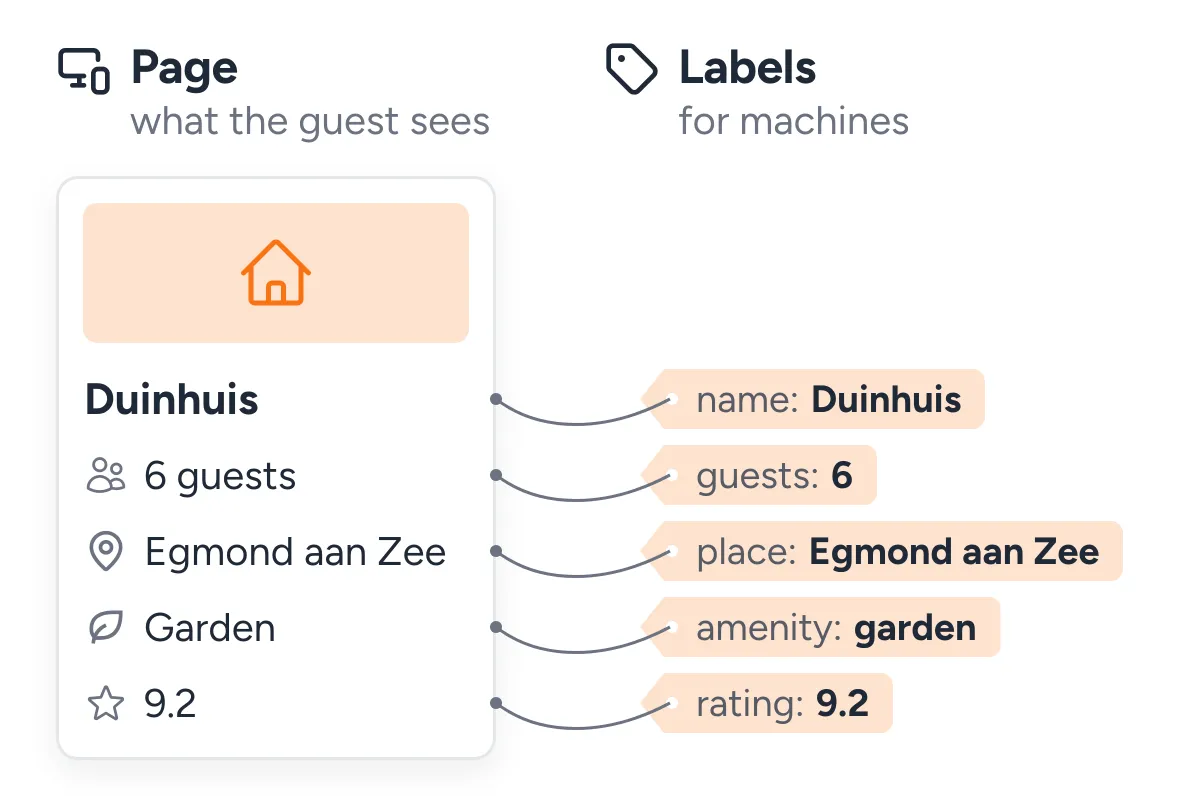
The fix is to place the important facts on the page a second time, now with a label attached. Not visible to the visitor, but in the page's source: this is the name of the accommodation, this is the address, this is the number of guests, this is a review that belongs to this accommodation. A person does not need those labels. A machine does.

This is called structured data. The standard format for it is JSON-LD. It sits in an invisible script in the page, next to the text the guest reads. What matters is that both come from the same source. The name in the label is the same name on the page, the guest count is the same count. The labelled version can never claim anything the visitor does not see.

Where the difference shows up

Picture a guest looking for a holiday home for six on the Egmond coast, with a garden. Increasingly, the guest asks that not of Google but of an AI assistant, in a full sentence. The answer that comes back is built from facts the assistant has been able to take from pages with confidence. An accommodation clearly labelled as sleeping six, sitting in Egmond and having a garden can land in that answer. One where the same facts appear only somewhere in a paragraph asks to be interpreted, and interpretation is where things fall out.

The same principle works at Google, shown differently. Labelled pages are easier for Google to place and to trust, which improves the odds of a richer result: not a bare blue link, but a result carrying extra context. Google decides for itself when and how to show that, so there are no guarantees. The groundwork for it, unambiguous facts in the page, is there regardless.

What BonBooking marks up

BonBooking builds this labelled version automatically, on every page, from the data the operator enters. Three kinds of fact go into it. On every page, who runs the site, with name, address and contact details, so a machine recognises the organisation behind the website. On an accommodation page, the things a guest weighs: the location, the maximum number of guests, the floor area, the amenities and the check-in and check-out times. Where reviews exist, the average goes in, along with the most recent ones.

Reviews deliberately keep the scale the site itself uses, a figure between 0 and 10, not converted to five stars, because five stars imply a different number.

Because the labelled version comes from the same input as the visible page, it is only as good as that input. An accommodation with its floor area filled in, its check-in times right and its amenities complete gives a machine more to work with than a half-filled entry. The labelling happens on its own. What goes into it stays the operator's work.

In closing

Speed and readability decide whether a page is read. Structured data decides whether it is also understood. Together they are the invisible layer beneath the photos, the reviews and the descriptions a guest finally goes by. None of the three convinces on its own, but without that layer the rest never gets its turn.

At BonBooking the labelling happens automatically, from the same data the page shows. The operator maintains no code and no loose labels, but does fill in the facts machines will later repeat. More on how that website is built can be found on the website features page.